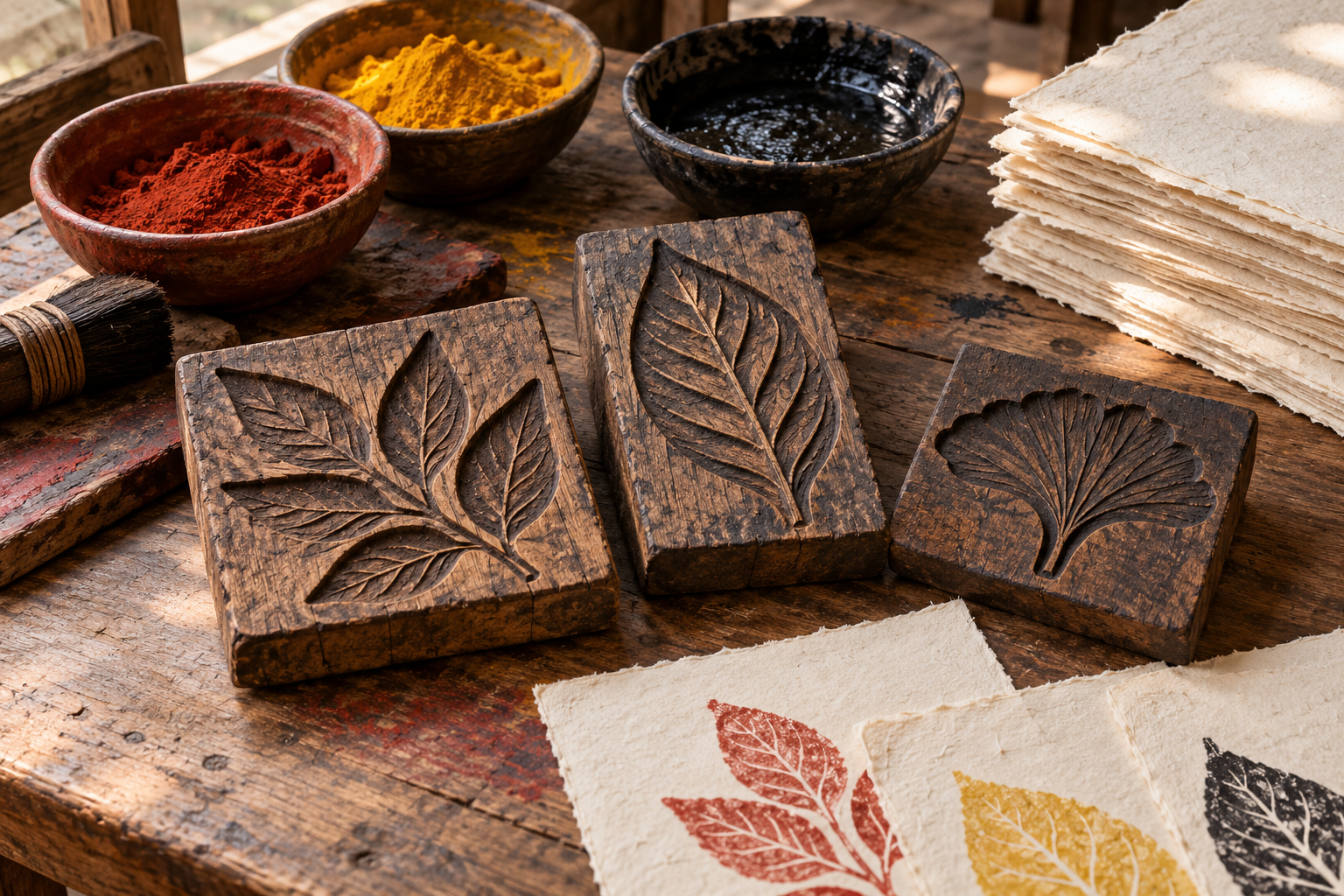
A colourful Đông Hồ picture is more than an image transferred onto ordinary paper. Its surface is part of the craft: shell powder gives the paper a luminous ground, while successive impressions from carved blocks build the picture. Understanding those two layers—the prepared sheet and the repeated printing—offers a useful way to look beyond the subject alone.
A village tradition, not a label for all Vietnamese art
Đông Hồ printing is associated with the village of that name in Bắc Ninh, northern Vietnam. The International Research Centre for Intangible Cultural Heritage (IRCI) documents its connection with Lunar New Year decoration. Vietnam News Agency’s account describes prints displayed in Red River Delta homes at Tết, with wishes for happiness and prosperity. This is a particular local print tradition; it does not describe every Vietnamese household or every Vietnamese painting.
Why the paper matters
The Bắc Ninh provincial cultural account identifies the support as dó paper coated with powdered shells. Vietnam News Agency additionally describes shell powder mixed with sticky-rice paste. Their terminology for the shell material differs, so “shell-coated paper” is a more useful general description here than treating one English shell name as a universal recipe.
For a viewer, the practical lesson is to look at the unprinted spaces too. The ground is a material choice, not simply a blank background. A digital reproduction can show the composition, but a screen alone cannot establish the texture or ingredients of the sheet.
How several blocks become one picture
Vietnam News Agency explains that separate blocks print the outline and colours, with the paper receiving successive impressions. UNESCO’s description likewise records a hand-worked process of design, carving, pigment preparation and printing, ending with black outlines. It is therefore misleading to imagine the entire coloured scene arriving in one stamp.
Think of the finished picture as a sequence of decisions preserved in wood. The carved forms make repeat impressions possible, but carving, preparing materials and aligning the impressions remain skilled work. Repetition is part of the method, rather than evidence that the object was mechanically printed.
Three questions for looking more closely
What is the support? Ask about the paper and coating rather than judging from brightness alone. How was it printed? Ask whether the image was hand-printed from blocks or reproduced by another process. Who made it? Request the maker’s name and workshop context. These are useful questions, not a foolproof authenticity test; colour, price or a souvenir label cannot settle provenance by itself.
Festival pictures and living skills
These works can combine everyday subjects with symbolic wishes. Vietnam News Agency lists livestock, daily activities, historical subjects and social commentary among their themes. A picture need not be a literal scene of a holiday to have had a place in seasonal home decoration.
Preserving the images and sustaining the skill are related but different tasks. IRCI’s 2013–2015 project, undertaken with the Vietnam National Institute of Culture and Arts Studies, brought practitioners, researchers and officials into discussions about transmission and community-led safeguarding. That documented project provides context, not a current count of practising families. We avoid recycling older household totals as today’s statistics.
Continue exploring materials
Compare the prepared surface and repeated impressions with ebru’s transfer of a floating pattern onto paper, or the way Baganda barkcloth transforms tree bark into a textile. These are distinct traditions, connected here by a viewing question: how much of an artwork’s meaning becomes clearer when we understand its material?
Sources and further reading
UNESCO: Craft of making Đông Hồ Folk woodblock printings; IRCI: safeguarding research, FY 2013–2015; Bắc Ninh provincial portal: Cultural beauty of Dong Ho Folk Painting; Vietnam News Agency: Dong Ho paintings—unique folk culture in Red River Delta, January 23, 2023. Source check: October 25, 2026. UNESCO and the provincial page were corroborated through indexed institutional text; direct retrieval was inconsistent. This article avoids disputed origin dates and unverified current practitioner totals.
Prepared with AI assistance for People & Origins from the linked sources. This is editorial synthesis, not firsthand reporting or a claim of specialist cultural expertise.


Leave a Reply