The pattern is made before the paper receives it. That is the useful starting point for understanding ebru, the Turkish art of marbling: the maker works with color on a liquid surface, then transfers the design to a sheet. The finished page preserves a stage of that moving pattern.
Both the Turkish National Commission for UNESCO and Metropolitan Museum of Art conservator Yana van Dyke describe this liquid-to-paper process. Their accounts also help explain why a marbled border is worth looking at separately from the writing it surrounds.
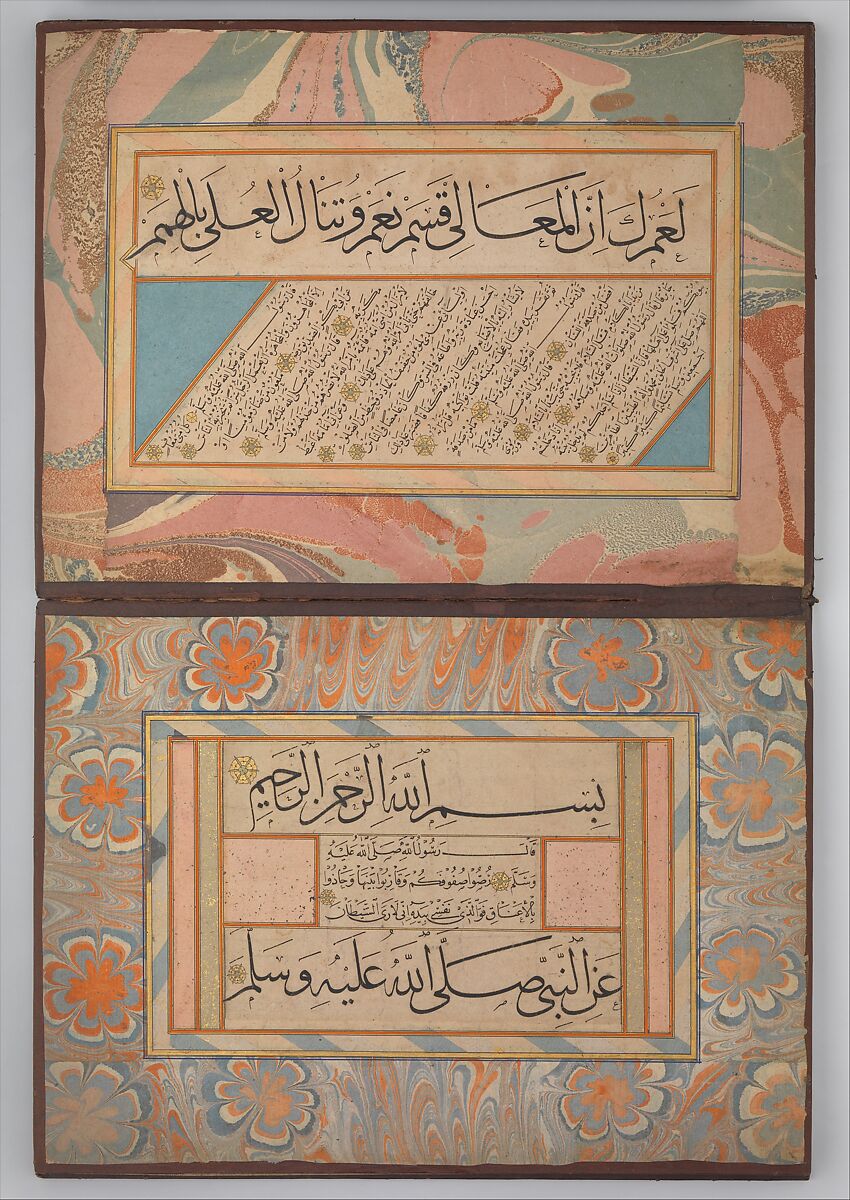
What happens between the tray and the sheet?
The bath is more than a container of plain water. Van Dyke describes a thickened liquid prepared with gum or algae, onto which colors are dropped or sprinkled. The National Commission likewise describes pigments applied to a prepared liquid surface. The design is then picked up by paper. These sources support the broad sequence; they do not establish one recipe for every practitioner. Met process explanation; National Commission description.
Pattern-making can include combing the floating color. In the Met’s illustrated account, different arrangements produce contrasting rhythms, from scattered marks to organized lines. The significant distinction for a viewer is between the stage when color is arranged on the bath and the stage when paper receives it. This is a reading guide, not a tested home-workshop tutorial.
Three ways to look at a marbled page
Use this original viewing checklist with the photograph above. It separates visible features from conclusions that need a catalogue record.
| Look for | What to ask | What not to assume |
|---|---|---|
| Large curves or repeated lines | How does the pattern change across the border? Process context | A pattern alone does not identify its maker. |
| Junctions between text and border | Where does the written panel end and its frame begin? Album record | The writing and decorated paper need not be the work of one person. |
| A place and date on the label | Does the label describe this object or the entire tradition? A contrasting Iranian folio | One object’s date is not the invention date of marbling. |
Why borders matter as much as the center
The Met’s album record describes written samples pasted onto marbled sheets with differing patterns. The photograph makes a useful exercise: briefly ignore the words and trace the space around them. Then return to the central panels. That change of attention is our suggested way of viewing the object, rather than a claim about the artist’s intentions.
Marbling is not confined to this Ottoman example. The Met also holds an unfinished marbled folio catalogued as made in Iran in the eighteenth century. Its record uses the Persian term abru alongside Turkish ebru and discusses framing for calligraphy and poetry. Together with the museum’s wider survey, it cautions against treating a familiar national label as proof of one exclusive origin.
A living practice, not just an old decorative effect
Ebru was inscribed on UNESCO’s Representative List of the Intangible Cultural Heritage of Humanity in 2014. The National Commission’s entry and UNESCO’s announcement of November 27, 2014 corroborate that recognition. Both describe learning through practical relationships between experienced makers and apprentices. The date marks recognition of the living tradition, not the beginning of the technique.
For a contemporary workshop, useful questions include which materials are being used, how the teacher learned, and whether the class demonstrates an established pattern or invites experimentation. Those are editorial suggestions for asking better questions; we have not visited or evaluated a workshop.
Continue with Mexico’s papel picado for another paper-based art, or our guide to reading kintsugi through museum objects. Each rewards close attention to materials while requiring its own historical context.
Sources and further reading
Yana van Dyke, The Met: The Art of Marbled Paper: Dynamic Fluids in Flow — technique and book-arts context.
The Met, collection record 1982.120.3 — the photographed album, attribution, date and public-domain image status.
The Met, Folio Decorated with Marbling, 2019.297.6 — a comparative Iranian example.
Turkish National Commission for UNESCO: Ebru, Turkish Art of Marbling; UNESCO’s November 27, 2014 announcement — process, transmission and inscription.
Source check: October 23, 2026. The viewing checklist is original synthesis of these sources and the collection photograph, not original reporting or an exclusive historical finding. No single invention date is asserted.
Editorial notice: Prepared for People & Origins with AI assistance using the sources above. No firsthand workshop experience or specialist credentials are claimed. The image is a public-domain museum photograph. See our Editorial Policy & AI Transparency.


Leave a Reply