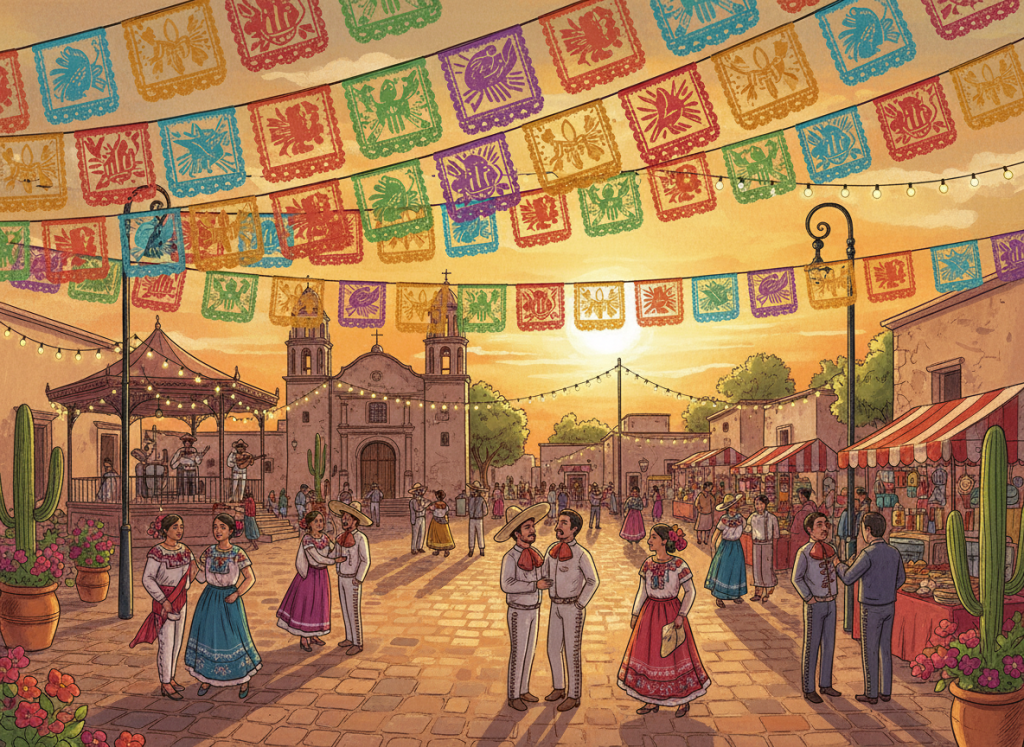
Look up during a celebration in Mexico and you may see rows of brilliant paper banners moving in the breeze. Pink, orange, purple, yellow and blue shapes turn sunlight into a shifting pattern. The decorations are called papel picado—literally, perforated or punched paper—and their delicate appearance hides remarkable skill.
The banners are familiar at many festivals, including Día de Muertos celebrations, but they are not limited to one holiday. They appear at weddings, community events, national festivities and family gatherings. Their meaning changes with the setting, which is precisely why they offer such an interesting window into Mexican visual culture.
How can tissue paper become art?
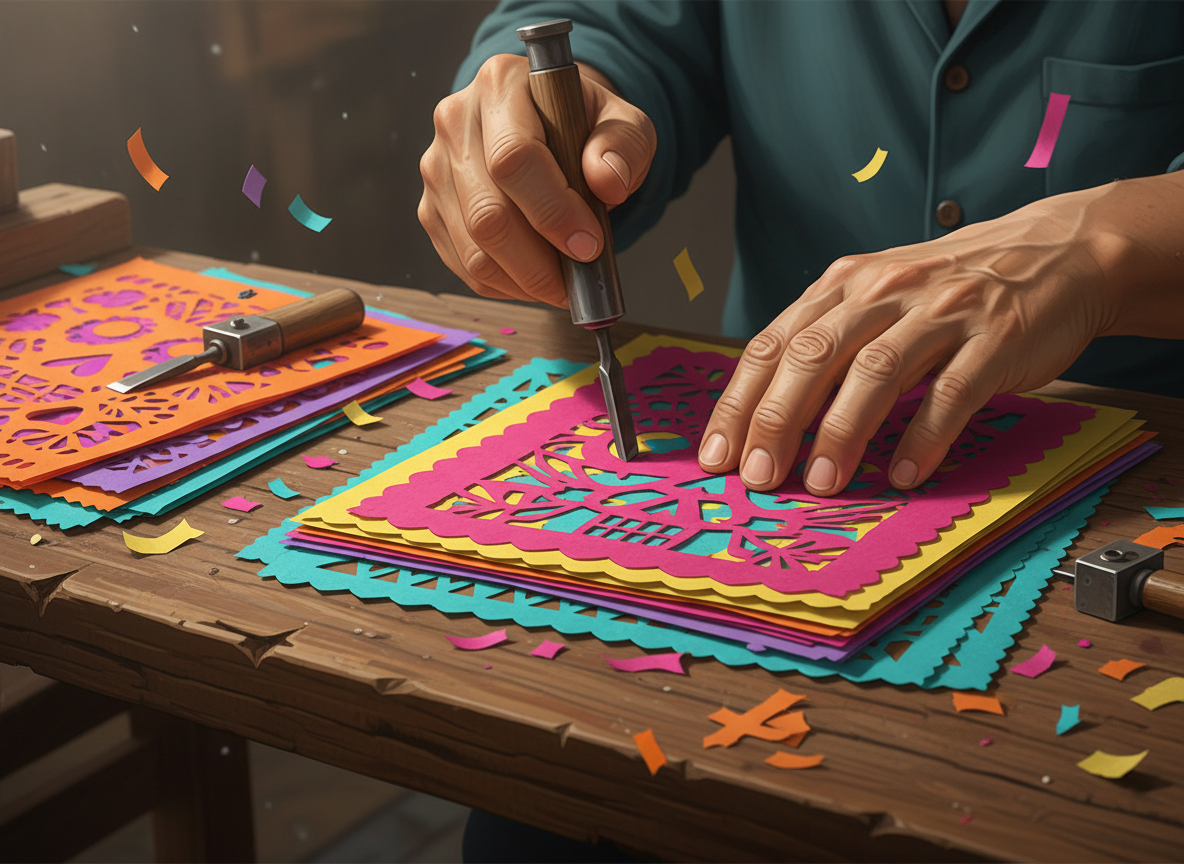
Traditional papel picado is often made by stacking sheets of thin paper and cutting patterns through the layers with chisels and a hammer. A skilled maker can produce repeated designs with extraordinary precision. Today, people also use scissors, punches, die-cutting and other methods, depending on the project and scale.
The openings matter as much as the paper left behind. Flowers, birds, letters, figures and intricate geometric motifs become visible through the contrast of color and empty space. When the banners are strung overhead, wind adds movement to the design.
Why it feels so alive
Papel picado changes a place without building anything permanent. A street becomes festive. A courtyard feels intimate. A market seems to have a colorful ceiling. Because the paper is light and often temporary, the decorations can also evoke the fleeting quality of a celebration: a moment created together and then allowed to pass.
In Día de Muertos settings, papel picado is frequently used on ofrendas, or remembrance altars. Interpretations of its symbolism vary; it is often associated with air or wind in popular explanations of the altar’s elements. It is important not to flatten the holiday into a single universal set of meanings. Families and communities observe it in different ways.
An art with a history of exchange
Paper-cutting has histories in multiple parts of the world, and the development of Mexican papel picado reflects changing materials and techniques over time. Tissue paper became especially useful for bright, lightweight decorations. The craft is strongly associated with communities such as San Salvador Huixcolotla in Puebla, known for its papel picado artisans.
Calling the banners simply ‘party decorations’ misses the expertise involved. Behind a row of fluttering designs may be hours of practiced handwork, pattern-making and knowledge passed between generations.
How to appreciate it respectfully
If you encounter papel picado at a festival, take a moment to notice the individual patterns rather than only the overall burst of color. If you purchase it, consider buying from artisans or sellers who identify the makers and methods. A handmade piece can carry a very different story from a mass-produced imitation.
You can also try making a simple paper-cut design yourself. The experience quickly reveals how much planning and care go into making something that looks so light and spontaneous.
A small object, a big idea
Papel picado reminds us that culture is not only preserved in monuments or museums. Sometimes it lives above our heads, moving in the breeze, transforming an ordinary street into a place where people gather and remember.
Further exploration
For more on Mexican cultural heritage, visit Mexico’s Secretariat of Culture and UNESCO’s overview of the Indigenous festivity dedicated to the dead.
Editorial note: The images in this article are AI-generated editorial illustrations and do not document a specific artisan or event.


Leave a Reply