A repaired bowl can seem to tell its whole story at a glance: it broke, somebody cared, and gold made the break visible. Look a little longer, though, and several different histories emerge. Who made the ceramic? Who repaired it? When did each happen? The answers need not belong to the same place or century.
What the gold actually does
Japan House London’s explanation of kintsugi describes a Japanese ceramic-repair practice using urushi, or Japanese lacquer, with powdered gold applied during finishing. Gold is therefore not simply a liquid poured into a crack. The joining and the metallic surface are different parts of the work. The Met’s tea-bowl record independently identifies gold lacquer repairs on a surviving object.
That distinction changes how we look. Instead of seeing one dramatic golden gesture, we can ask about the material that holds the fragments together and the finish that makes the intervention visible. This is a way to read a repair, not a set of instructions for attempting one.
One bowl, more than one geography
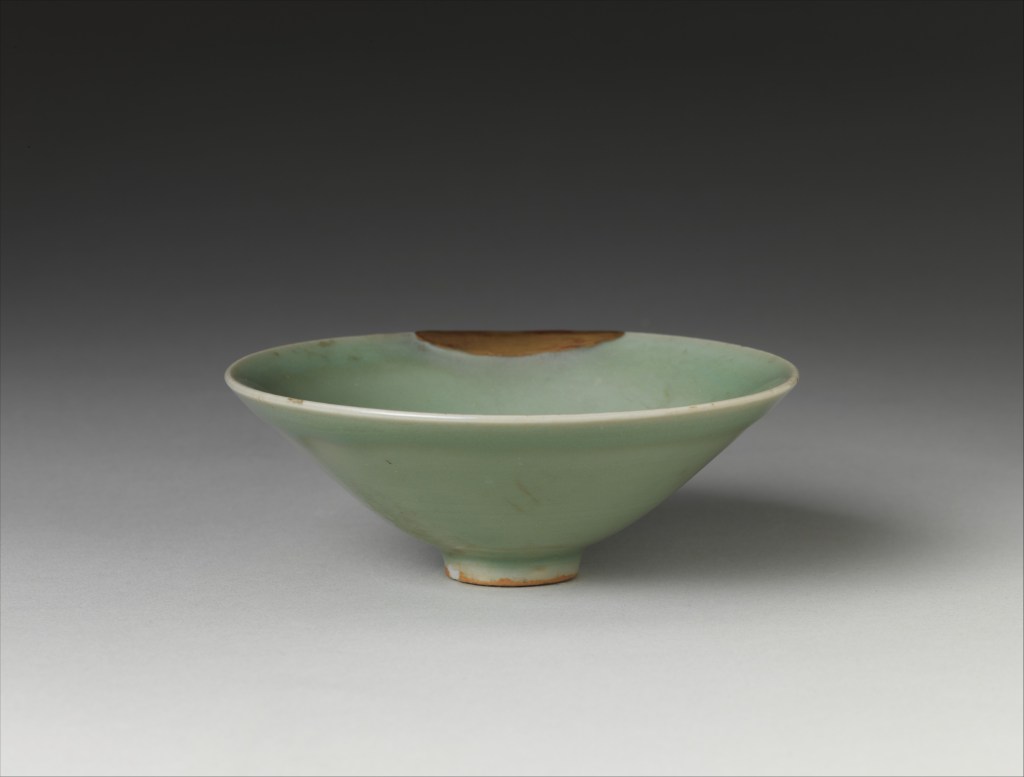
The Met catalogs the pictured bowl as Chinese Longquan ware. Its curatorial note interprets the kintsugi as evidence suggesting that the vessel was used and valued in Japan. The wording matters: this is an inference about the bowl’s later life, not the name of a documented repairer. Read the object record alongside the image.
A useful museum habit follows: read the ceramic’s place of production separately from the repair’s cultural context. The two can illuminate exchange rather than cancel each other out. Nor should we transfer the bowl’s age automatically to the gold-colored area. A date attached to an object is not a date for every alteration it carries.
A surprising complication: an imitation repair
A second Met record complicates the familiar broken-then-mended story. A tea jar by Eiraku Tokuzen lists an imitation gold lacquer repair among its materials and techniques. That description gives us a reason to ask whether a visible feature records damage, evokes the appearance of repair, or requires closer curatorial explanation. It does not give us permission to invent an accident behind the jar.
The comparison is the point: two gold-related surfaces need not document the same sequence of events. Attention to catalog wording can reveal more than a confident caption built from appearance alone.
Four questions for reading a repaired ceramic
| Ask | Check | Avoid assuming |
|---|---|---|
| What is being dated? | The ceramic, an alteration, or both. | Every repair is as old as the vessel. |
| Where was it made? | Production information separately from later use. | One country label describes its entire life. |
| What materials are named? | Lacquer, metal powder and other stated materials. | A gold-colored surface establishes composition. |
| How is the feature described? | Repair, restoration or imitation repair. | A visible line proves a particular breakage story. |
Leave room for uncertainty—and for the craft
Japan House notes that kintsugi’s exact beginnings are unknown and identifies a frequently repeated founding story as legend. We therefore do not assign the practice a single proven inventor here. Its account also describes related approaches with silver, plain lacquer or replacement fragments: the gold finish is part of a wider world of repair. Its illustrated guide offers the technical context.
A reader may find a personal metaphor in a repaired object. That response can coexist with attention to the craft, but it should not stand in for evidence or speak for all Japanese people. The less immediately visible questions—materials, intervention and provenance—help keep the object from disappearing behind a slogan.
For other ways to think about an artwork’s lifespan, explore our articles on rangoli’s temporary patterns and Mexico’s papel picado. These are different practices; comparing the questions we ask is more useful than assigning them one shared meaning.
Sources and further reading
Japan House London: Kintsugi—Japanese Repair Technique — lacquer, finishing, related repair methods and uncertainty about origins.
The Metropolitan Museum of Art: Tea bowl, object 16.122.5 — catalog identification, interpretation of later use, and public-domain photograph.
The Metropolitan Museum of Art: Eiraku Tokuzen’s sencha tea jar, object 25.60.31a, b — the catalog’s imitation-repair description.
Optional reading: explore the craft further
Affiliate disclosure: People & Origins may earn a commission if you purchase through the Bookshop.org link below.
Kintsugi: The Poetic Mend by Bonnie Kemske explores the history and techniques of ceramic repair. It is a relevant next step for readers interested in a longer treatment of the craft. We selected it using the publisher’s description; we have not independently reviewed the book.
Editorial transparency
Prepared for People & Origins with AI assistance. This is a source-based explainer, not firsthand reporting, an appraisal or a claim of conservation expertise. The four-question framework and comparative observations are our editorial synthesis. Sources and image rights checked October 22, 2026. The image is a credited museum photograph; no AI illustration is included. The optional book recommendation contains a disclosed Bookshop.org affiliate link added October 22, 2026. The book was selected using publisher information and was not used as a source for this article. See our Editorial Policy & AI Transparency or send a correction.


Leave a Reply