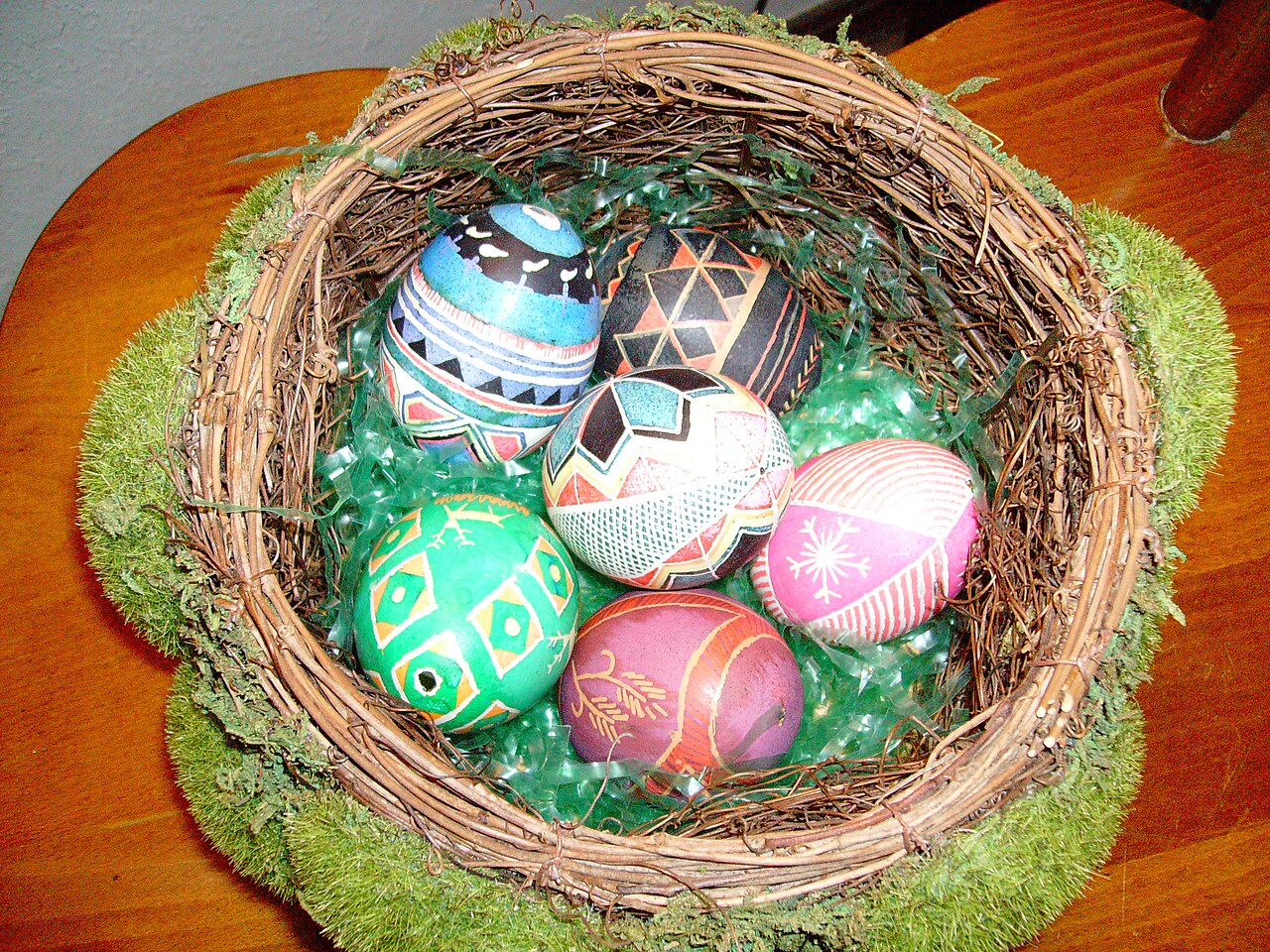
A finished pysanka can look like a tiny painted sculpture. Yet the key to its pattern is what the dye cannot reach. The University of Kansas guide explains that wax protects parts of the shell while the egg takes on colour. Understanding that sequence changes how you look at the finished object: a light line can be a surface preserved earlier, rather than paint added at the end.
Why “written” is the useful word
Pysanka is singular; pysanky is plural. Kansas connects the name with the Ukrainian verb pysaty, meaning to write. Its guide describes a small funnel tool called a kistka for placing hot wax on the shell. Independently, the Estonian National Commission for UNESCO describes the decoration as writing with wax, followed by dipping the eggs in colour. This is a wax-resist process, rather than simply brushing a finished picture onto an egg.
Read the process in three stages
Protect: wax covers selected areas of shell. Colour: dye reaches the exposed surface. Reveal: removing the wax exposes the protected design. The University of Kansas guide describes repeated writing and dyeing before the wax is removed. The useful distinction is between a material that temporarily masks the surface and the colour that remains.
This sequence offers a way to appreciate the maker’s planning without guessing the meaning of each motif. Look for how pale lines divide coloured areas, then ask how successive protected areas could have built the design. That is a reading suggestion based on the technique, not a claim to reconstruct the exact steps used for any particular egg in the photograph.
A gift carries more than a pattern
The Estonian National Commission for UNESCO describes Easter as an important setting for making and giving pysanky. Its account also records gifts for births, christenings and marriages, and says the eggs are kept rather than intended for eating. Those are documented practices, not instructions that every Ukrainian household follows. A decorative egg should not be assumed to be an edible Easter treat.
The same institutional account describes workshops at the Ukrainian Cultural Centre in Tallinn. This matters to a culture guide: the tradition is also maintained in diaspora communities, and the location of a workshop does not by itself tell you the cultural identity of the practice. The photograph here is explicitly a Ukrainian-American family’s modern interpretation.
Three questions worth asking a maker
What technique did you use? A decorated egg’s appearance alone may not establish its process. Where did this design come from? A family example, a regional reference and a new composition need different descriptions. What does this motif mean to you? A maker’s explanation is more useful than treating an online symbol chart as a universal dictionary. These questions are editorial suggestions, not a fixed etiquette code.
The strongest first introduction is therefore modest: learn the wax-resist sequence, identify the maker and context, and leave room for meanings you have not established. We do not assign symbolic meanings to the individual patterns in the image, because its file record does not document them.
For other ways materials shape a design, read how ebru transfers a pattern from water to paper and how Chechen istang uses felt. These are distinct traditions; the comparison concerns craft processes, not shared origins.
Sources and further reading
University of Kansas guide; Estonian National Commission for UNESCO; Canadian Museum of History: Ukrainian Easter egg. Sources checked 24 October 2026. This is a cultural introduction, not a heated-wax craft tutorial.
AI-assisted editorial notice: Prepared by People & Origins with AI assistance for research and drafting. The viewing questions are original synthesis, not firsthand reporting or specialist testimony. Read our Editorial Policy & AI Transparency.


Leave a Reply