A carpet can look like a drawing while its pattern is actually assembled from pieces. Chechen istang offers a striking example: a felt-carpet tradition in which the work of forming wool and the work of arranging ornament meet. The regional heritage register identifies it as a Chechen craft; a Museum of the Chechen Republic account independently describes plain and patterned varieties.
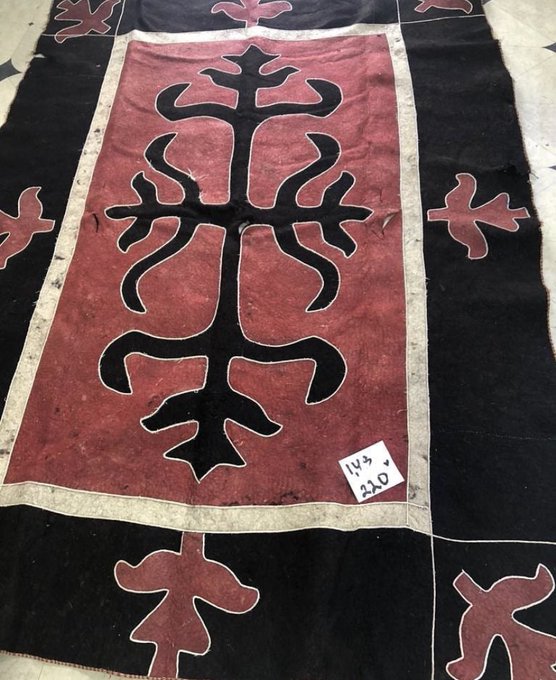
What makes an istang different from a woven carpet?
The starting point is wool felt. In the register’s documented process, makers lay out wool, wet it and work a rolled bundle until it becomes a dense sheet. For decorated examples, they cut shapes from differently colored felt, stitch the ornament into the composition and finish its outlines with braid. A patterned surface therefore need not be a pattern woven into cloth.
The Chechen museum’s account of felt-carpet making describes this as labor-intensive work historically undertaken mainly by women. It also records variety: one-color and multicolored carpets, fringed examples and ornamented forms. “Istang” should not be reduced to one color scheme or one decorative recipe.
One object makes the technique easier to understand
The Russian Museum of Ethnography’s catalog supplies a useful anchor: object РЭМ 9988-70, described as a Chechen kora-istang from Aslanbek-Sheripovo, dated to the 1930s. Its materials include wool felt, cotton fabric and cotton threads. Its techniques include felting, sewing, mosaic and braiding. The record shows why both the main surface and its joins deserve attention.
That catalog entry and the photograph above document different objects. The photograph shows a red central field, black branching forms, a dark border and pale outlines. Those are visible observations. Its Commons description identifies a Chechen istang from Kezenoy-Am but does not establish the maker or production date. Keeping those limits visible makes the comparison more useful.
A short guide to looking closely
| Start with | What the evidence supports | What to leave open |
|---|---|---|
| Material | Museum object РЭМ 9988-70 lists wool felt, cotton fabric and cotton thread. | A photograph alone cannot identify every fiber. |
| Construction | The same record lists felting, sewing, mosaic and braiding; the heritage register describes cutting and stitching ornament. | Not every carpet uses an identical combination. |
| Motif | The Chechen museum’s account names plant, antler and celestial motifs. | Resemblance does not establish a particular maker’s intended meaning. |
| Date and place | The museum record dates its Aslanbek-Sheripovo example to the 1930s. | That date belongs to that object, not the photographed carpet above. |
A home furnishing, and a record of skilled work
The heritage register describes carpets used for domestic decoration and warmth. Separately, MARKA’s felt-craft catalog records wall and floor uses, sleeping and protection against cold. A display on a museum wall can emphasize design; these accounts remind us that the textile also had practical roles.
A useful way to look is to follow one outline from the center toward the edge. Where does a shape repeat? Where does its color change? Which boundaries seem emphasized by trim? These questions invite close attention without requiring a ready-made story about what the maker believed. They are viewing suggestions, not a claim to have examined the carpet in person.
Why every shape does not come with a fixed translation
The museum account names motifs associated with plants, deer antlers, the sun, stars and a crescent. That gives a vocabulary for comparison, not permission to label every branching shape in every carpet. This article does not assign a spiritual meaning to the photographed design or claim that the tradition represents every Chechen household today.
The focus here is a documented Chechen craft. Other peoples have their own felt traditions, and a shared material does not erase distinct cultural identities. A careful description starts with the named community, then the particular object and its evidence.
Continue exploring traditional arts
For another way a process shapes an image, read how ebru transfers a pattern from water to paper. For a different approach to patterned surfaces, explore Mexican papel picado. These are connections through making, not claims of a common origin.
Sources and further reading
Regional Register of Intangible Ethnocultural Heritage of the Chechen Republic: istang-making technology (Russian). Technique and domestic-use account; includes named contributors and a bibliography.
Museum of the Chechen Republic: lecture on felt-carpet-making technology (Russian). Independent institutional account of varieties, makers and motif vocabulary.
Russian Museum of Ethnography: Chechen kora-istang, РЭМ 9988-70 (Russian). Object-specific materials, techniques, location and dating.
MARKA: Decorative and Applied Arts of Russia, felt-carpet-making series (English). Additional institutional description of domestic uses. This is a reference, not a purchase recommendation.
Wikimedia Commons: Chechen Istang from Kezenoy-Am. Photograph provenance and reuse license.
Source-check date: 23 October 2026. Russian-language source descriptions are paraphrased in English. This is original editorial synthesis and a viewing guide, not original field research.
AI-assisted editorial notice: Prepared by People & Origins with AI assistance for research, drafting and source comparison. No firsthand visit or specialist credentials are claimed. Read our Editorial Policy & AI Transparency.


Leave a Reply