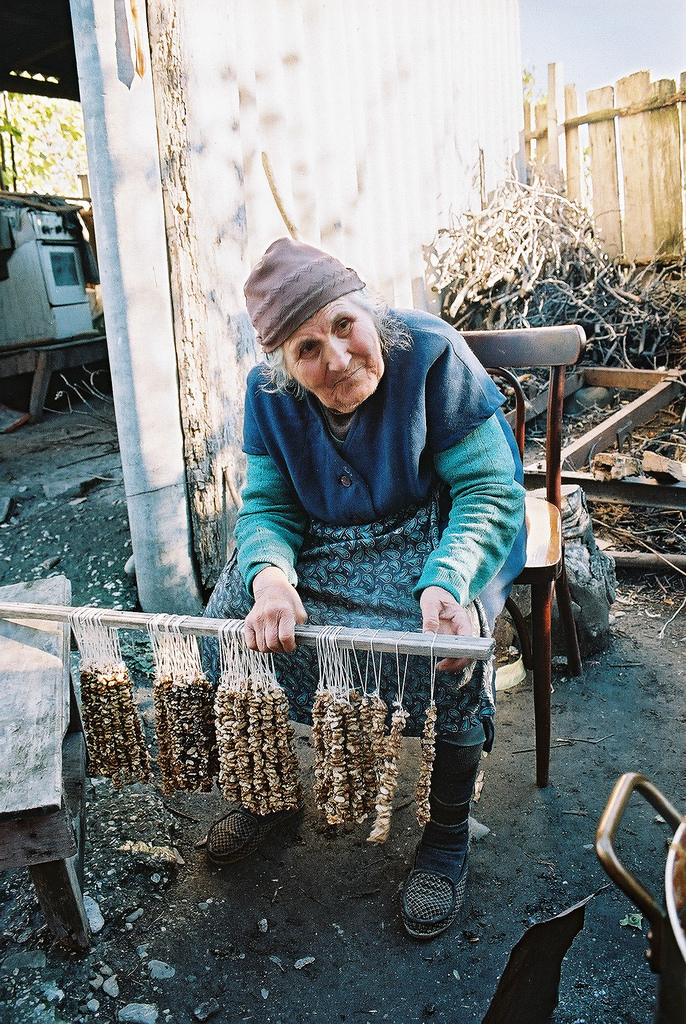
Churchkhela’s shape is a clue to its construction. Beneath the fruit coating is a thread holding nuts or other ingredients together. Both Georgia’s National Tourism Administration and Slow Food Foundation’s Ark of Taste describe repeated dipping in thickened juice, followed by drying. This Georgian sweet is therefore assembled from the inside outward: the string supports a centre, and successive coatings build its exterior.
What holds the coating together?
Georgia’s National Tourism Administration calls the wheat-flour-thickened grape preparation tatara. Its account describes walnut halves in Kakhetian churchkhela. Slow Food Foundation’s Ark of Taste independently records wheat flour in eastern Georgian examples and describes heating the juice with flour before dipping the threaded ingredients. Flour is part of the coating’s structure, not merely a dusting on a finished sweet.
One name does not mean one recipe
Slow Food Foundation’s Ark of Taste records a broader range of centres, including hazelnuts, almonds, pumpkin seeds and dried fruit, and also describes mulberry juice. These examples explain why a walnut-and-grape description is a useful introduction but an incomplete definition of every version.
For western Georgia, Georgia’s National Tourism Administration describes a related sweet called janjukha, highlighting hazelnuts and corn flour in Guria, Samegrelo and Imereti. Slow Food also records corn-flour-thickened preparations in western regions. These are regional descriptions, not a promise that every household or producer uses the same ingredients.
A small glossary for reading a description
Churchkhela: the threaded, coated sweet discussed here. Tatara: the thickened grape preparation named in the tourism administration’s account. Pelamushi: the name Slow Food uses for western corn-flour-thickened grape juice. Janjukha: a related western Georgian sweet in the tourism account. Treat these as a guide to those sources’ usage, rather than interchangeable labels for every local recipe.
Why the harvest matters
The two accounts connect production with grapes and the harvest; Slow Food Foundation’s Ark of Taste places usual production in autumn, alongside ripening nuts. The useful connection is agricultural: ingredients becoming available together help explain the preparation’s seasonal setting. This does not mean a shop display can tell you when a particular strand was made.
Three questions that reveal more than the colour
What is inside? Ask which nuts, seeds or fruit form the centre. What is the coating? Ask about the juice and thickener. Where does this recipe come from? A producer’s regional or family explanation can add context that appearance alone cannot supply. These questions are our synthesis of the documented variations, not a formal Georgian etiquette rule.
They also help avoid confident guesses. A photograph cannot establish an ingredient list, added colouring, production date or dietary suitability. Read the label or ask the maker rather than assuming two similar strands contain the same things. This article is an introduction to a food tradition, not a recipe, storage guide or assessment of an individual product.
For other stories about food’s social context, explore welcoming guests with food and Moroccan mint tea. Each tradition needs its own local explanation; these links invite comparison rather than imply a common origin.
Sources and further reading
Georgia’s National Tourism Administration: Churchkhela; Slow Food Foundation’s Ark of Taste: Churchkhela. Sources checked 24 October 2026. Regional terminology and ingredient examples are attributed to their accounts; this article does not establish a single historical inventor or an exclusive origin claim.
AI-assisted editorial notice: Prepared by People & Origins with AI assistance for research and drafting. The glossary and viewing questions are original synthesis, not firsthand reporting or culinary expertise. Read our Editorial Policy & AI Transparency.


Leave a Reply