A cloth laid flat does not announce what it will carry. Fold it around a box, bring its corners together, or leave the folds untied, and the same piece becomes a different kind of wrapper. That flexibility is the useful starting point for understanding furoshiki.
What is furoshiki? It is a Japanese wrapping cloth used for objects and gifts, with applications beyond gift presentation. Japan House London explains its adaptability to boxes, bottles and rounded objects; the Japan Foundation’s teaching programme also identifies everyday lunch-box wrapping. The Environment Ministry’s illustrated guide offers ways to adapt the cloth to different loads.
Begin with the job, rather than the knot
A useful first question is whether you want to present something or transport it. A neat parcel resting on a table has a different job from a bundle carried by hand. Our guide below organizes the sources around that decision. It is a way to choose which demonstration to study, not a substitute for learning the folds.
The distinction also prevents a common oversimplification: furoshiki wrapping does not always require a knot. Japan House London’s demonstration includes a knotless method as well as tied approaches. The ministry’s downloadable diagram sheet is a useful companion for following the physical arrangements.
A small guide to choosing what to learn
| Your purpose | Demonstration to consult | Question to ask before using it |
|---|---|---|
| A casual gift or lunch box | Otsukai-tsutsumi, presented as a basic wrap in Japan House London’s guide. | Does the cloth comfortably cover this particular object? |
| A presentation without a visible knot | Hira-tsutsumi, the knotless approach in the same demonstration. | Will it remain supported while being presented? |
| A long or rounded object to carry | Compare the shape-specific examples in the ministry’s diagram sheet with Japan House’s examples. | Have you practised the arrangement with a light, non-fragile item first? |
The final column contains our practical prompts, not traditional rules. Cloth dimensions, fabric behaviour and the object all affect a real attempt. This article does not certify a knot, cloth or bundle as safe for a particular weight.
What a museum cloth can—and cannot—tell you
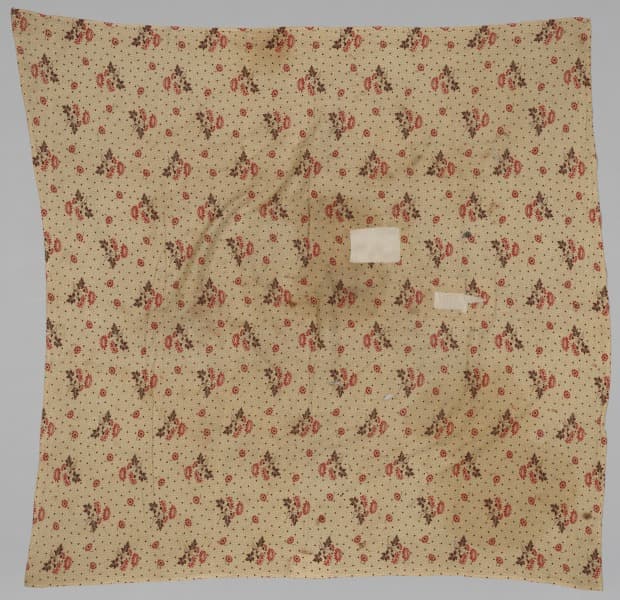
The photographed wrapper is catalogued by the Cleveland Museum of Art as Japanese cotton from the 1800s. Laid flat, its pattern is visible as a whole. A useful viewing exercise is to imagine which parts would remain visible when folded, then compare that idea with an actual demonstration. That is an invitation to look closely, not a reconstruction of how this particular cloth was used.
An object label and a wrapping demonstration answer different questions. The label documents a surviving textile; the demonstration explains an arrangement. Neither alone tells you what every household does, or establishes a single date when cloth wrapping began. We therefore do not assign an invention date here.
Reuse is an action, not just a description
The Japan Foundation’s workshop description emphasizes reusable cloth, while the Environment Ministry provides techniques that allow a cloth to serve different purposes. For a gift, one practical way to keep reuse possible is to explain what you intend: is the cloth part of the gift, or will you take it home after unwrapping? That is our communication suggestion, not a claim about one universal Japanese etiquette rule.
This approach keeps the focus on something the giver and recipient can actually decide. We make no numerical claim about waste or carbon savings, and no assumption that buying a new cloth is automatically the best choice in every situation.
For related close-looking guides, explore ebru’s transfer from liquid to paper and what a kintsugi repair can tell you. All three invite attention to materials, without treating their cultural settings as interchangeable.
Sources and further reading
Japan House London: Wrapping in Japan—finding beauty in function — named wrapping methods and their different purposes.
Japan’s Ministry of the Environment: How to use Furoshiki, including its illustrated PDF — demonstrations for different objects.
The Japan Foundation, Sydney: Japanese Cloth Wrapping Workshop — an archived teaching programme documenting gift and everyday applications; not a current event listing.
Cleveland Museum of Art: Wrapper (Furoshiki), 1920.1948; Open Access terms — photograph, object record and CC0 reuse.
Source check: October 23, 2026. This decision guide is original synthesis, not original reporting. The suggestions have not been tested by us as a carrying tutorial.
Editorial notice: Prepared for People & Origins with AI assistance using the linked institutional sources. No firsthand practice or specialist expertise is claimed. The image is a museum photograph, not an AI illustration. Read our Editorial Policy & AI Transparency.


Leave a Reply