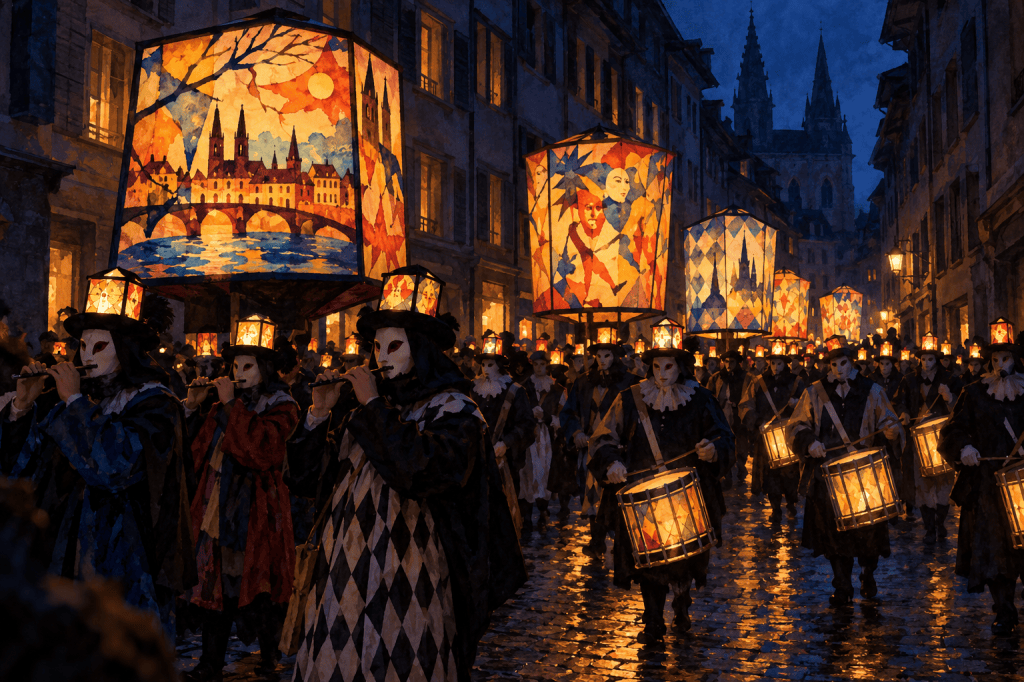
At four in the morning, a festival usually sounds like something that should be ending. In Basel, Switzerland, it is the beginning. The city centre’s lights go out, lanterns become the main illumination, and piccolos and drums announce Fasnacht.
That opening, called Morgestraich, offers a useful way to understand the celebration: look beyond the costumes and ask what people are communicating. Basel’s carnival is also a public conversation, carried through painted images, music, and jokes.
A precise beginning, a changing message
Fasnacht begins on the Monday after Ash Wednesday and runs for 72 hours, ending early Thursday. The opening’s darkness and musical procession are described by both the Swiss Federal Office of Culture and the Fasnacht Committee. This timing belongs to Basel’s particular tradition; it should not be treated as the schedule for every Swiss carnival.
The recurring framework does not mean that each year repeats the same story. Groups develop new themes, responding to events and controversies. A familiar festival can therefore become a way to discuss an unfamiliar year.
The lantern is more than decoration
Basel Tourism explains that a group’s sujet, or theme, can appear on its large lantern and be echoed in masks, costumes, and props. Its official carnival guide also describes the lantern exhibition on Münsterplatz, where viewers can examine the designs outside the moving procession.
Here is a simple viewing exercise: first notice the main figure or object, then look for what seems exaggerated, and finally ask which current event might make the image meaningful. You may not solve the joke. That is a reason to seek context rather than assume the artwork is merely strange.
Our interpretation is that the lantern works on two levels: it catches attention as an illuminated object and invites closer reading as a comment. The first can cross a language barrier immediately; the second may depend on local knowledge.
Listen for the difference between music and commentary
Piccolo and drum groups are central to the opening. Tuesday evening brings Guggenmusik brass bands, while other parts of the celebration include Schnitzelbänke: satirical songs and verses. The Federal Office of Culture emphasizes the importance of these performances and the local Basel dialect.
The Swiss government’s comparison of Basel and Lucerne carnivals adds another form of commentary: satirical leaflets distributed by participants. Taken together, these forms suggest a useful question for visitors: is this moment inviting you to listen, look, read, or laugh?
A tradition also needs beginners
The committee describes Tuesday afternoon as an occasion for children to practise carnival traditions with accompanying adults. It also describes opportunities after carnival for newcomers to try instruments and creative activities. Those quieter learning moments deserve attention alongside the spectacle.
A procession is the visible result; practice and teaching help make it possible. This is an editorial observation, not a claim that every participant has the same experience or motivation.
How to approach it respectfully
Start with curiosity about the specific group or artwork in front of you. Avoid turning one costume into a statement about all Swiss people. When a joke depends on dialect or politics you do not know, leave room for uncertainty. For practical attendance details, check the committee’s current guidance rather than relying on a general cultural article.
For another perspective on how seasonal celebrations organize shared time, read our introduction to Sweden’s Midsummer. The traditions differ; comparing their practices can be more revealing than treating every festival as the same kind of party.
Basel Carnival was inscribed on UNESCO’s Representative List of the Intangible Cultural Heritage of Humanity in 2017, as confirmed by the Federal Office of Culture. Its lanterns are memorable, but the people who compose, rehearse, paint, and teach are part of the story too.
Sources and further reading
Swiss Federal Office of Culture: Basel Carnival — opening time, performance traditions, and UNESCO inscription.
Fasnacht Committee: The carnival year — lantern procession, children’s activities, exhibitions, and learning opportunities.
Basel Tourism: Carnival in Basel — themes, costumes, lantern art, and programme context. Check the year attached to individual programme entries.
Swiss federal authorities: Basel and Lucerne—when carnival becomes art — regional differences and satirical leaflets.
Editorial transparency
Prepared for People & Origins with AI assistance from the linked institutional and organizer sources, checked on October 22, 2026. This is a source-based cultural explainer, not firsthand reporting. Interpretive observations are identified above. No affiliate links are included. The illustration is AI-generated and is not documentary evidence. See our Editorial Policy & AI Transparency.


Leave a Reply